Run each campaign as an experiment
A campaign is a question you ask the market. Decide in advance what answer counts as yes, how many emails it takes to hear it, and when you'll stop. Then read the verdict once.
Why averages won't tell you if it works
The usual question is "what reply rate is normal?" It has no useful answer. The question that does is "what reply rate makes this worth doing for us?"
Published reply rates come from the customers of the tools that publish them. They blend products, markets, offers and price points that have nothing in common. A number that mixes a $50-a-month tool with a six-figure platform can't tell you whether your campaign worked.
So this chapter never says what reply rate to expect. It shows you how to set your own bar, how many emails it takes to clear it, and how to read the result without fooling yourself.
Count replies written by a person, not opens. Open tracking is unreliable: pixels get pre-fetched, and some providers warn recipients about them.
Set the threshold from your economics
The threshold is the reply rate at which the answer is "yes, this works". It comes from what a reply is worth to you, not from anyone else's data.
Cold email pays for itself when the deals from replies cover the cost of the sends and your time. Solve that for the reply rate and you get the break-even point per email sent:
threshold = all-in cost per email ÷ (ACV × reply-to-deal conversion)
"All-in" means domains, mailboxes, data, software and your time, divided by the emails you send.
$30,000 ACV
Threshold: 1.5%
One reply in ten closes. Each email costs $45 all-in, counting your time. $45 ÷ ($30,000 × 0.1) = 1.5%.
$600/year product
Threshold: 12%
The same one-in-ten conversion. Even at $7.20 per email, $7.20 ÷ ($600 × 0.1) = 12%.
There is no single right number, only yours. Write it down before the first email goes out, and never move it after you see results.
Use rates per email sent. In a two-step sequence, everyone who doesn't reply to the first email gets a second. The rate per email is then roughly half the rate per lead. Set your threshold in the same unit you'll measure.
The free Experiment Planner calculates your threshold from ACV, conversion and cost per email, then tells you how many sends it takes to reach a verdict.
Open the Experiment PlannerWhat it costs to find out
Once the threshold is set, the next question is how many emails it takes to know. Decide that number before you send, and read the verdict when you reach it.
The table shows sends to a verdict, from Sellvance's Signal Check. Interest rows give an 80% chance of a "works" verdict. The delivery row is exact: after 299 sends with no out-of-office reply at all, a 1% baseline is rejected. Nothing is judged below 30 sends.
| What's tested | Threshold | If the true rate is | Sends |
|---|---|---|---|
| Delivery (zero out-of-office replies) | 1% | 0% | 299 |
| Interest | 3% | 6% | ~282 |
| Interest | 3% | 8% | ~127 |
| Interest | 3% | 10% | ~66 |
| Interest | 3% | 15% | ~36 |
| Interest | 5% | 15% | ~52 |
| Interest | 10% | 25% | ~40 |
None of these rows says what reply rate you'll get. Each says what it costs to know. The stronger the offer against your threshold, the cheaper it is to prove. A precise segment and a message written for it move you down the table.
When unsure, size for the lowest rate you'd still act on. It takes more sends, but the verdict holds either way. If the planned sample is more than you can afford, change the experiment, not the rule: test a narrower segment or a bolder offer.
Decide the stopping rules before you send
Write these next to the hypothesis before the first email goes out. Then the verdict is a lookup, not a debate.
Works
Delivery passes, replies conclusively above the threshold
This segment, persona and offer beat your bar. Scale it as a separate campaign, so the experiment's numbers stay clean (Chapter 5).
Doesn't work
Delivery passes, replies conclusively below
This offer, written this way, to this segment, doesn't clear the bar. Change one thing (segment, persona or offer) and retest on fresh companies. Change two and you won't know which one mattered.
Grey zone
Delivery passes, still inconclusive at the planned sample
The true rate is close to your threshold. Extend once, by at most half the planned sample. If it's still inconclusive, the answer is "not clearly above": treat it as no and move on.
Invalid
Delivery fails
No conclusion about the market is possible. Don't read the replies. Pause, fix delivery (Chapter 1), and restart on fresh companies.
Delivery and unsubscribes can end an experiment early. If unsubscribes are conclusively above your limit, pause: the offer or the list is wrong for these people, whatever the replies say. Interest is read once, at the planned sample.
Every Sellvance campaign has a Signal Check with three verdicts: delivery, interest and harm, each with a confidence interval. Interest is blocked while delivery fails, so a spam-folder zero never reads as "doesn't work".
See offer validationCommon mistakes that fake a verdict
Each of these produces an answer that looks real and isn't.
- Reading replies before delivery. Zero replies fits a bad offer and a spam folder equally well. Our own July 2026 wave sent 337 emails across 13 campaigns and got zero replies and zero out-of-office replies. The cause was a sending IP with no reverse DNS record, not the 13 segments.
- Peeking daily at the verdict. Check often enough and noise will hand you a verdict sooner or later. Watch delivery and unsubscribes daily. Read interest once, at the planned sample.
- Changing copy mid-test. Any edit to the subject, body or sequence starts a new experiment. The sends before it don't count.
- Moving the threshold after seeing results. Then the test only describes what happened. Set it first and leave it.
- Confusing per-lead and per-send rates. A multi-step sequence spreads the same replies over more emails. Measure and set the threshold in replies per email sent.
- A contaminated sample. Companies that already heard from you are answering a second email, not your offer.
The Experiment Playbook covers the full method: writing the hypothesis, the delivery gate, keeping samples fresh with a saved search's rejected list, and a step-by-step procedure an AI agent can follow through the Sellvance MCP server.
Read the Experiment PlaybookSend so the test stays clean
Sending practice protects your domains. During an experiment it also keeps the conditions the same from the first send to the last.
Ramp up gradually
A sudden jump in sending is a strong spam signal. Start new mailboxes low and raise the daily count over a few weeks, and keep warmup running alongside cold sends.
| Timeline | Cold emails / day per mailbox |
|---|---|
| Day 1 | 5 |
| Day 5 | 10 |
| Day 10 | 15 |
| Day 15 | 20 |
| Day 20 | 25 (maximum) |
Rotate mailboxes, send in business hours
Spread sends across mailboxes so no single one carries the load. With enough mailboxes, rest half of them each week. Keep the set of sending mailboxes the same for the whole experiment: swapping them mid-test changes delivery.
Send during business hours in the lead's timezone. An email that lands at 3 a.m. sits under a pile by morning.
Fix the sequence shape before you start
Decide the number of steps and the delays between them, then leave them alone until the verdict. Adding a step mid-test changes what you're measuring.
Keep it short for an experiment: two or three steps. Each follow-up should add something, such as a different angle on the same problem or a plain yes/no question. The last step can say you won't write again. Don't send "bumping this up".
Plan the sample in sends, then work back to leads: leads needed ≈ planned sends ÷ number of steps. Stop enrolling when you reach it and let the follow-ups finish.
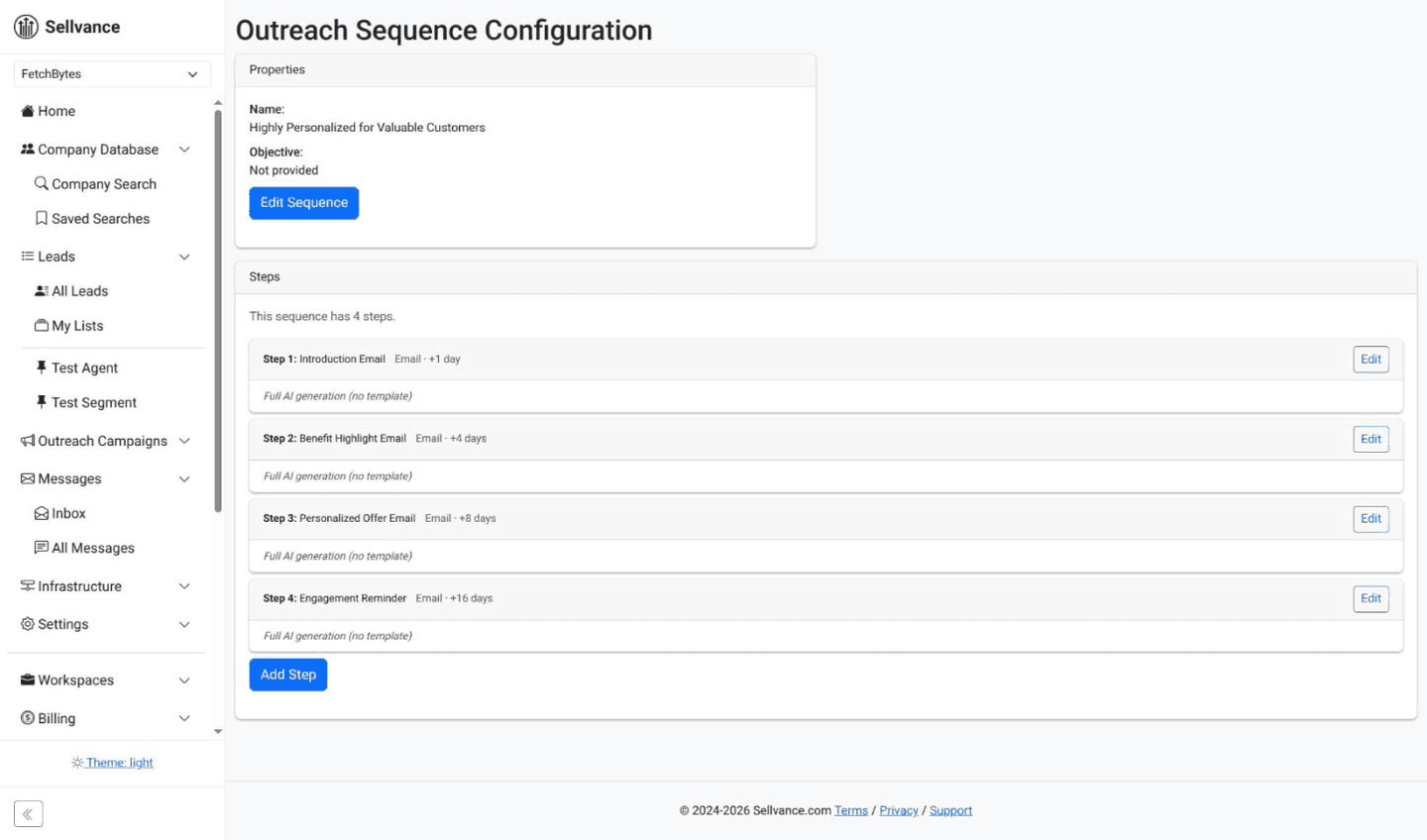
Sellvance sends in each lead's timezone, rotates mailboxes and respects daily limits. Validate a campaign by hand on a few leads, then turn on autopilot: it pulls fresh companies, enriches and qualifies them, and writes and reviews each email. Set the daily add limit to zero once the planned sample is enrolled.
See outreach automationTrack cost per answer, not ROI benchmarks
An experiment's output is a verdict. So the number to watch is what each verdict costs you.
For every experiment, write down:
- Emails to a verdict: the planned sends, plus any grey-zone extension.
- Mailboxes: how many it took to send that sample at safe daily limits.
- Time: calendar days from first send to verdict, and your own hours building and reviewing.
- Money: emails to a verdict × your all-in cost per email.
This is why a sharper segment and a stronger offer pay twice. They raise the chance of a "works" verdict, and they make every verdict, including "no", cheaper to get. Once you have a "works", Chapter 5 covers how to scale it.
Get a Verdict, Not a Guess
Sellvance runs your campaign and checks it against your threshold: delivery first, then interest and harm, each with a confidence interval.
Start your first experiment